Key takeaways
- Verify that London landscapers carry current WSIB clearance, liability insurance, and, where applicable, Landscape Ontario membership before you sign anything.
- London sits in Canadian Hardiness Zone 5b (USDA 6a) with a growing season of roughly 141 days, so timing and material choices matter as much as who you hire (Government of Canada Plant Hardiness Zones, Almanac.com).
- Compare at least three itemized quotes on the same scope, not the same lump sum, so you can see where the money actually goes.
- Ask for a written schedule, a payment structure tied to milestones, and a warranty on both workmanship and plant material.
- The best London landscapers integrate design, hardscaping, and carpentry so your project has one team, one timeline, and one point of accountability, which is how Bond Landscape & Design is structured.
Hiring London landscapers is one of the higher-stakes decisions a homeowner makes each year, and the wrong choice usually shows up in cracked interlock, sagging fence posts, or plants that never made it past the first winter. This guide walks you through exactly how to vet landscape contractors in London, Ontario so the finished project holds up to Southwestern Ontario winters, heavy clay soils, and your resale timeline.
This article is for London homeowners, cottage owners in nearby Port Stanley and Port Bruce, and property managers in Ilderton, Komoka, Ingersoll, St. Thomas, or Tillsonburg who are getting quotes for a landscape, hardscape, or carpentry project this season.
What “landscaper” actually means in London, Ontario
The word “landscaper” covers a very wide range of businesses in London. Before you shortlist anyone, it helps to know which category you are actually shopping for.
| Type of contractor | Typical scope | When to hire them |
|---|---|---|
| Lawn maintenance company | Mowing, fertilizing, spring/fall cleanup | Weekly upkeep, no build work |
| Garden centre installer | Planting, mulch, small beds | Refresh existing beds |
| Hardscape crew | Interlock, patios, walkways, driveways, retaining walls | Structural exterior work |
| Landscape designer | Master plans, planting design, 3D renderings | Whole-property planning |
| Full-service landscape and design studio | Design, hardscape, carpentry, and planting under one roof | Complex or multi-phase projects |
If your project touches more than one of those columns (for example, a new patio with a fence and a planting refresh), you will save time and money by hiring a full-service studio rather than coordinating three separate trades yourself. Studios like Bond Landscape & Design run design, hardscape, and carpentry through a single project manager, which is the model this guide assumes when it says “London landscapers.”
The 7 non-negotiable credentials to check first
Every quote you accept in London should come from a contractor who can produce these seven documents on request.
- WSIB clearance certificate. Ontario’s Workplace Safety and Insurance Board covers crew injuries. Without a valid clearance, an injury on your property can become your problem. Verify at wsib.ca using the contractor’s account number.
- Commercial general liability insurance. Ask for a minimum of $2 million and confirm the policy is current. Have the certificate emailed to you directly from the broker if possible.
- Landscape Ontario membership (recommended). Landscape Ontario is the provincial trade association. Membership is voluntary but signals continuing education and a code of practice.
- HST number. Any London landscaper billing more than $30,000 in taxable revenue per year must be HST-registered. No HST number on the invoice is a red flag.
- A local business address. London-based crews know the city’s clay soil, freeze-thaw cycle, and permit process. Search the address on Google Maps before you commit.
- A verifiable portfolio. Ask for the addresses (or at least the neighbourhoods) of three completed London projects you can drive past. Byron, Masonville, Old North, and Hyde Park are common Bond project areas and a good sanity check for local experience.
- Written references from the last 12 months. Call two of them. Ask specifically about schedule adherence, cleanup, and how change orders were handled.
If a contractor hesitates on any of these seven, move on. The good London landscapers expect these questions.
How to compare quotes (apples-to-apples, not apples-to-orchards)
The single biggest reason homeowners overpay or under-scope is that they compare quotes that describe different projects. Force every bidder to price the same scope by giving them a one-page brief.
Your brief should include:
- Property address and lot dimensions
- Photos of the existing space from four angles
- A short list of “must-haves” (for example: 400 sq ft patio, three-season use, room for a six-person table)
- A short list of “nice-to-haves” (for example: gas line rough-in, low-voltage lighting)
- Your target start window and hard deadlines (a wedding, a listing date, a baby due date)
- Your budget range, stated as a range not a ceiling
Then ask each contractor to itemize their quote by line: excavation, base preparation, materials, labour, disposal, permits, and contingency. A lump-sum “$34,000 for the patio” tells you nothing. An itemized quote tells you whether the crew is planning six inches of compacted 3/4-inch clear stone base (the right answer for a London freeze-thaw climate) or two inches of screenings on top of clay (the wrong answer).
What London’s climate and soil mean for your quote
London sits in Canadian Hardiness Zone 5b, or USDA Zone 6a, with winter lows between –25 °C and –20 °C (Government of Canada Plant Hardiness Zones). The last spring frost is around May 15 and the first fall frost around October 4, giving a growing season of about 141 days (Almanac.com). Most of the city sits on heavy alkaline clay that retains moisture, drains slowly, and compacts easily.
Those three facts change how a competent quote should read.
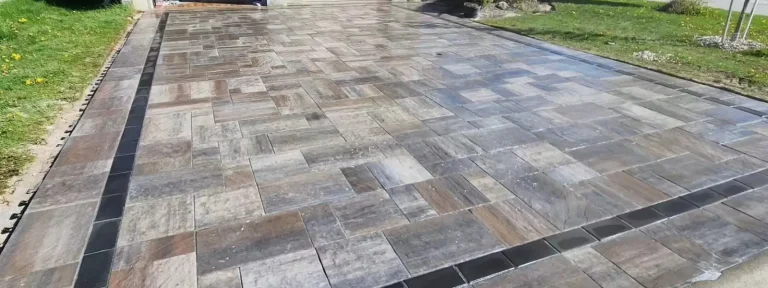
- Base depth for hardscape. Freeze-thaw movement in London clay demands a minimum 6-inch compacted granular base for patios and walkways and 10 to 12 inches for driveways. Any London landscaper quoting less is quoting a callback in year two. See Bond’s interlock page for how a properly bedded install is described.
- Drainage plan. Because clay drains slowly, your quote should mention slope (typically 1% to 2% away from the house), swales, or a French drain where the grade demands it. Water pooling after rain is a solved problem, not a fact of life.
- Plant selection. Clay-tolerant, Zone 5b-hardy species survive London winters. Any plant list on your quote should be species-specific (“Karl Foerster feather reed grass,” “Limelight hydrangea”) rather than generic (“perennials, shrubs”).
- Install window. Interlock and retaining walls can be installed from roughly mid-April through late November in most London seasons. Planting is safest between the last spring frost and roughly six weeks before the first fall frost.
If a quote does not address base depth, drainage, plant hardiness, and install window, ask the contractor to revise it before you compare prices.
Design first, price second
Most disputes between homeowners and London landscapers start when the crew shows up to build something that was never fully drawn. A short design phase, even for a single patio, prevents 80% of change orders.
A proper design package for a London property includes:
- A scaled site plan with existing features (house, driveway, utilities, mature trees) marked
- A proposed layout with dimensions
- A materials schedule (paver style and colour, wall block, deck species, fence style)
- A planting plan keyed to Zone 5b-hardy species
- A 3D rendering for any project over roughly $25,000
Bond’s landscape design service uses master plans, 3D renderings, and planting design so the client sees the finished space before a single stone is laid. That workflow is worth asking any shortlisted London landscaper to match, even in a lighter form.
Contracts, payment schedules, and warranties
Once you have chosen your contractor, the contract is where you lock in the promises made during the quote stage. A well-written landscape contract in London should include:
- Scope of work in numbered line items that mirror the quote
- Materials specification by brand, product line, and colour code
- Start and substantial completion dates, with a defined process if weather delays occur
- Payment schedule tied to milestones, not the calendar: a common structure is 20% deposit, 40% at material delivery, 30% at substantial completion, 10% at final walkthrough
- Change order process in writing, requiring both parties to sign before any extra work begins
- Workmanship warranty of at least two years on hardscape and one year on carpentry
- Plant warranty of at least one growing season on installed plant material
- Cleanup and disposal clause covering excavated soil, packaging, and jobsite condition at the end of each day
Never pay more than 20% up front, never pay the final 10% before your walkthrough, and never accept a verbal change order.
Red flags that should end the conversation
Any one of the following should be enough to disqualify a London landscaper.
- Cash-only pricing “to save the HST”
- No physical business address or a residential address with no signage
- A quote emailed as a phone photo of a handwritten page
- Pressure to sign the same day for a “this-week discount”
- Refusal to name the specific paver, wall block, or deck species they will install
- No proof of WSIB or liability insurance within 24 hours of your request
- Reviews that all appear within a two-week window with similar wording
Frequently asked questions
How much do London landscapers charge for a patio?
Fully installed interlock patios in London typically run $35 to $60 per square foot as of 2026, depending on paver line, base depth, site access, and add-ons like lighting or a seat wall. Very small patios often price higher per square foot because mobilization costs are fixed.
What is the best month to hire a landscaper in London, Ontario?
January through March is the best time to book a build for the coming season. Most reputable London landscapers fill their spring and early-summer schedules by early April, and design lead times of four to eight weeks are common.
Do I need a permit for landscaping in London, ON?
You do not need a permit for most planting, patio, or fence work under six feet, but you do for pool enclosures, decks over 24 inches, retaining walls over one metre, and any work in a regulated conservation area. Confirm with the City of London building services before construction starts.
How long should a landscape project take in London?
A standalone patio typically takes 5 to 10 working days, a full backyard renovation 3 to 6 weeks, and a full-property landscape 6 to 12 weeks, weather dependent. Design phases add another 3 to 8 weeks up front.
What is the difference between a landscaper and a landscape designer?
A landscape designer plans the space on paper, produces the renderings, and specifies materials. A landscaper builds the plan. A full-service studio like Bond Landscape & Design does both under one roof, which removes handoff friction between design and construction.
Next steps
If you have already gathered a couple of quotes and want a benchmark, book a design consultation with a full-service London studio and compare their scope of work to what you have received. For a broader look at how a project comes together on a London property, read our companion guide, Landscaping in London, Ontario: The Complete 2026 Guide, which covers seasonal timing, materials, and planting choices for Zone 5b properties. When you are ready to talk about your own project, visit the Bond Landscape & Design contact page or browse recent installs on the projects page and gallery.